

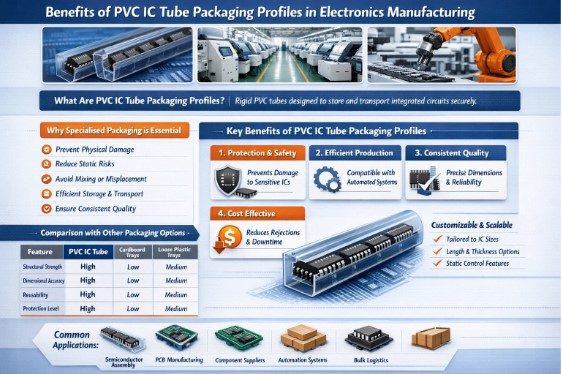
In electronics manufacturing, small details often decide product quality and production efficiency. One such detail is how integrated circuits are stored, handled, and transported during production.
This is where industrial PVC IC tube packaging profiles play a practical role. These profiles are designed to protect IC components, support organised handling, and maintain consistency across large-scale manufacturing processes.
This article explains how PVC IC tube packaging profiles work, why they matter, and how they support modern electronics manufacturing in real-world conditions.
What are PVC IC Tube Packaging Profiles?
PVC IC tube packaging profiles are rigid plastic tubes used to store and transport integrated circuits and electronic components. They are designed with precise internal dimensions so ICs fit securely without movement or damage.
Unlike generic packaging, these profiles are engineered for industrial use, where accuracy, durability, and repeatability are essential.
In simple terms, they act as structured carriers that keep IC components safe, aligned, and ready for automated or manual assembly.
Why Electronics Manufacturing Needs Specialised Packaging
Electronics manufacturing involves thousands or millions of components moving through production lines. Even minor damage or misalignment can cause defects, delays, or losses.
Common challenges include:
- Physical damage during handling
- Static electricity affecting sensitive components
- Mixing or misplacement of ICs
- Inefficient storage and transport
- Inconsistent packaging quality
PVC IC tube packaging profiles help reduce these risks by providing a stable and controlled packaging system.
Key Benefits of PVC IC Tube Packaging Profiles
1) Protection of delicate IC components
Integrated circuits are sensitive to pressure, vibration, and impact. PVC tubes hold components firmly in place, reducing the risk of bending, cracking, or surface damage.
The rigid structure ensures:
- Minimal movement during transport
- Reduced friction between components
- Better resistance to external stress
This is especially important in high-volume production environments.
2) Support for organised and efficient production
In modern electronics manufacturing, speed and accuracy are critical. PVC IC tube packaging profiles help maintain order in component handling.
They allow:
- Easy loading and unloading of ICs
- Compatibility with automated systems
- Clear identification and sorting
This improves workflow efficiency and reduces manual errors on assembly lines.
3) Consistent quality in industrial PVC profiles
One major advantage of industrial PVC profiles is dimensional stability. IC tube profiles are manufactured with tight tolerances so that each tube maintains the same shape and size.
This consistency supports:
- Reliable machine feeding
- Uniform stacking and storage
- Predictable performance across batches
For manufacturers, consistent packaging means fewer disruptions in production.
4) Cost efficiency in large-scale operations
Although specialised packaging may seem like an added cost, it often reduces overall expenses in the long term.
PVC IC tube packaging profiles help lower costs by:
- Reducing component damage and rejection rates
- Minimising production downtime
- Improving logistics and storage efficiency
For companies working with bulk production, these savings become significant over time.
5) Flexibility for custom requirements
Different IC components vary in size, shape, and sensitivity. PVC tubes can be produced in custom dimensions to match specific technical requirements.
Customisation options include:
- Internal channel design
- Length and thickness variations
- Material hardness levels
- Surface finish
This makes PVC IC tube packaging profiles suitable for diverse applications in electronics manufacturing.
Role of PVC IC Tube Profiles in Safe Component Handling
In real production environments, handling practices directly affect product quality. Packaging systems must support not only storage but also safe movement of components.
PVC IC tube profiles contribute to safe handling of sensitive IC components by reducing direct contact, limiting exposure to environmental factors, and maintaining structural stability during transport and assembly.
When integrated into a broader handling process, these profiles help maintain component integrity from supplier to final assembly.
Comparison with Other Packaging Options
| Feature | PVC IC Tube Profiles | Cardboard Packaging | Loose Plastic Trays |
| Structural strength | High | Low | Medium |
| Dimensional accuracy | High | Low | Medium |
| Reusability | High | Low | Medium |
| Industrial suitability | High | Limited | Moderate |
| Protection level | High | Low | Medium |
This comparison shows why PVC IC tube packaging profiles are preferred in industrial environments.
Practical Use Cases in Electronics Manufacturing
PVC IC tube packaging profiles are widely used in:
- Semiconductor assembly lines
- PCB manufacturing units
- Electronics component suppliers
- Automation-based production facilities
- Bulk storage and logistics systems
For example, when ICs are transported between different stages of production, PVC tubes ensure components remain aligned and undamaged. This reduces rework and quality issues.
Manufacturers such as M3 Extrusion produce industrial PVC profiles designed to meet technical specifications required by electronics companies. These profiles are developed for consistent performance in repeat production and project-based requirements.
Factors to Consider When Choosing PVC IC Tube Profiles
Before selecting PVC IC tube packaging profiles, manufacturers should evaluate:
Material properties
- Impact resistance
- Static control requirements
- Durability under industrial conditions
Dimensional accuracy
- Compatibility with IC size and shape
- Tolerance levels for automated systems
Production scalability
- Ability to support bulk orders
- Consistency across large batches
Application environment
- Storage conditions
- Handling processes
- Transport requirements
Choosing the right profile design helps align packaging with production needs.
Quick Takeaways for Manufacturers
- PVC IC tube packaging profiles support protection, organisation, and efficiency in electronics manufacturing.
- Industrial PVC profiles provide consistency and durability required for high-volume production.
- Custom designs help match technical specifications of different IC components.
- Proper packaging reduces damage, errors, and operational costs.
These factors make PVC IC tube profiles a practical choice for industrial electronics applications.
FAQs
1) What are PVC IC tube packaging profiles used for?
PVC IC tube packaging profiles are used to store, transport, and handle integrated circuits in electronics manufacturing. They keep components aligned and protected, reducing damage and handling errors. Their rigid structure supports efficient production and bulk storage in industrial environments.
2) Why is PVC preferred for IC tube packaging?
PVC is preferred because it offers strength, dimensional stability, and durability at a reasonable cost. It can be manufactured with precise tolerances, making it suitable for industrial applications where consistency and reliability are required across large production volumes.
3) How do PVC IC tubes help in electronics manufacturing?
PVC IC tubes help by protecting sensitive components, improving organisation on assembly lines, and supporting automated handling systems. They reduce component damage, improve workflow efficiency, and support consistent packaging standards in electronics manufacturing processes.
4) Can PVC IC tube profiles be customised?
Yes, PVC IC tube profiles can be customised based on component size, shape, and technical requirements. Manufacturers can adjust dimensions, thickness, and internal design to match specific applications, making them suitable for different electronic components and production systems.
5) Are industrial PVC profiles suitable for bulk production?
Industrial PVC profiles are suitable for bulk production because they maintain consistent quality across large batches. Their durability and dimensional accuracy support repeat production, making them reliable for long-term industrial use in electronics manufacturing.
6) What should manufacturers check before selecting IC tube packaging profiles?
Manufacturers should check material properties, dimensional accuracy, compatibility with automated systems, and production scalability. Evaluating these factors helps ensure the packaging profiles align with operational requirements and protect electronic components effectively.
